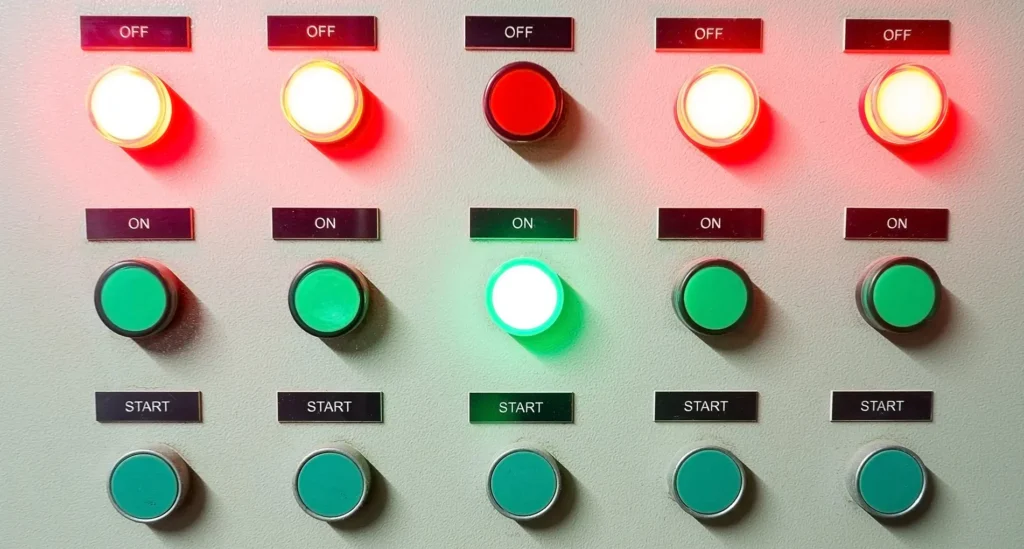
Valve position feedback tells you more than whether a valve is powered—it confirms whether it’s actually open or closed. That distinction matters for sequencing, interlocks, alarms, troubleshooting, and safer maintenance.
In this blog, I answer the most common questions our customers ask about specifying it correctly.
What does valve position feedback mean, and how is it different from just having an actuator move the valve?
An actuator’s job is to move the valve — nothing more. It applies force to open or close the valve, but it doesn’t tell you whether the valve actually got there. Valve position feedback closes that gap. It’s an electrical signal, typically from a limit switch mounted on the actuator, confirming the valve reached its fully open or fully closed position.
Without feedback, you’re trusting that a command was executed. With it, you have confirmation. That distinction sounds small until a valve sticks, an actuator stalls, or a coupling slips/breaks — situations where “commanded” and “actual” position quietly diverge, often without any other warning sign.
When does a project genuinely need valve position feedback, versus relying on the actuator’s own end-of-travel stop?
A valve actuator’s internal end-of-travel stop — mechanical or torque-based — only tells the actuator when to stop moving. It doesn’t report anything outside itself. Position feedback becomes necessary once something else needs to know the valve’s status: a PLC making the next move in a sequence, an HMI displaying system state to an operator, or a safety interlock that shouldn’t proceed until a valve is confirmed closed.
If the valve is in an accessible spot and a quick visual check is good enough, you may not need it. But once decisions—automated or human—depend on valve position, feedback stops being optional.
How does valve position feedback support sequencing and interlocks in a control system?
Sequencing depends on knowing that one step actually finished before the next one starts. If a chiller bypass valve needs to close before a pump engages fully, or a diverting valve needs to confirm its position before a batch process continues, the control system needs a real signal—not an assumption based on elapsed time.
Interlocks work the same way. A safety interlock that prevents equipment from running until a valve is confirmed open or closed is only as reliable as the feedback behind it. Without it, the interlock is trusting a timer, not a fact. For applications like these, it’s worth specifying valve limit switches with dual open/closed outputs.
Can open/closed position feedback trigger alarms when a valve fails to reach its commanded position?
Yes, and this is one of the more practical reasons to specify it. When a control system sends a close command, it expects a closed-position signal back within a set time window. If that confirmation doesn’t arrive—because the valve stuck, the actuator stalled, or a mechanical linkage failed—the system can flag a fault instead of silently assuming success.
This is often called a “mismatch” or “failure to seat” alarm. It’s a small addition to the control logic, but it turns a hidden failure into a visible one. In processes where an unconfirmed valve position could mean a wrong mix, a pressure event, or a safety concern, this alarm is often the difference between catching a problem in seconds and finding it hours later.
How does a valve position feedback switch interface into a PLC or control system?
Most position feedback switches use dry contact outputs—one for open, one for closed—that interface directly into a PLC’s digital input card. Each contact closes when the valve reaches that position, giving the PLC a simple true/false signal per state. No special communication protocol is required for basic monitoring.
Wiring specifics depend on the switch type. Mechanical switches use physical contacts rated for a given voltage and current. Solid-state versions switch electronically and tend to hold up better under frequent cycling. Either way, confirm voltage compatibility with the PLC input card before ordering. Assured Automation’s solid-state proximity switches are a common fit for PLC-based systems.
How does a position feedback switch simplify troubleshooting on an automated valve?
Without feedback, diagnosing a stuck or misbehaving valve often means walking out to the field to check it manually—sometimes repeatedly, if the problem is intermittent. With position feedback, the control system already knows what the valve is doing, so troubleshooting starts at a screen instead of going out to the field.
A technician can compare the commanded position against the actual reported position and immediately narrow down where the problem sits: actuator, wiring, switch, or valve itself. That distinction matters in time-sensitive situations and cuts down on unnecessary field visits—especially valuable for valves in hard-to-reach or hazardous locations.
Does valve position feedback improve safety during maintenance and lockout/tagout procedures?
Yes. Before a technician works on equipment downstream of a valve, they need confidence that it’s actually in the position they think it’s in—not just that a command was sent. Position feedback provides that confirmation independently of the command itself, which is exactly what lockout/tagout procedures are built to require.
This matters most in systems where a valve failing to fully close could expose a technician to pressure, flow, or hazardous material. A verified closed signal, checked against the control system before work begins, adds a layer of confirmation that a visual glance or an assumption can’t reliably provide.
Mechanical or proximity: which position feedback technology fits which application?
Mechanical switches use physical contacts that close when a cam engages them. They’re simple, inexpensive, and easy to troubleshoot, but the physical contact means more wear over high cycle counts. Solid-state proximity switches sense position electronically, with no physical contact—better suited to frequent cycling or environments where mechanical wear is a concern.
Environment matters too. Washdown areas, vibration-heavy equipment, and high-cycle applications tend to favor proximity switches for longevity. Simpler, lower-cycle applications often do fine with mechanical switches at a lower cost. Assured Automation offers both mechanical and solid-state proximity switches, so the choice comes down to duty cycle and environment, not availability.
What NEMA ratings matter when specifying a valve limit switch for position feedback?
NEMA ratings describe how well an enclosure holds up against environmental exposure—not electrical performance. NEMA 4 and 4X cover general-purpose, washdown-resistant applications: protection against water, dust, and corrosion in standard industrial settings. That’s sufficient for most indoor or sheltered installations.
Hazardous locations raise the bar. If a valve sits where flammable gases, vapors, or dust are present—common in chemical processing or certain pharmaceutical applications—the enclosure must match the site’s specific Class/Division classification.
Because these requirements vary by facility and application, confirming exact rating needs with an automation specialist beats assuming one switch fits every hazardous environment. Assured Automation’s limit switch line spans multiple enclosure ratings to match.
Beyond just requesting an “actuated valve,” what should you put in the spec to make sure position feedback is included and wired correctly?
“Actuated valve” alone doesn’t specify whether position feedback is included — that has to be called out separately. A complete spec should state the switch type (mechanical or solid-state proximity), the number of outputs needed (open only, closed only, or both), and the enclosure rating suited to the installation environment.
It should also cover electrical details: voltage and current compatibility with the receiving PLC or control system, conduit entry size, and mounting standard (ISO 5211 or NAMUR, depending on the actuator). Leaving any of these unspecified risks a mismatch that shows up during commissioning, not before. Assured Automation’s position feedback switch options cover most of these combinations.
Not sure which valve position feedback switch fits your application—mechanical, proximity or NEMA 4X? Assured Automation’s in-house valve automation experts can help you spec the right limit switch, valve actuator, and wiring configuration for your process.
Need Help? Call Us Now at +1 800-899-0553 or contact us to talk about your open/closed position feedback requirements today.

Vice President of Sales