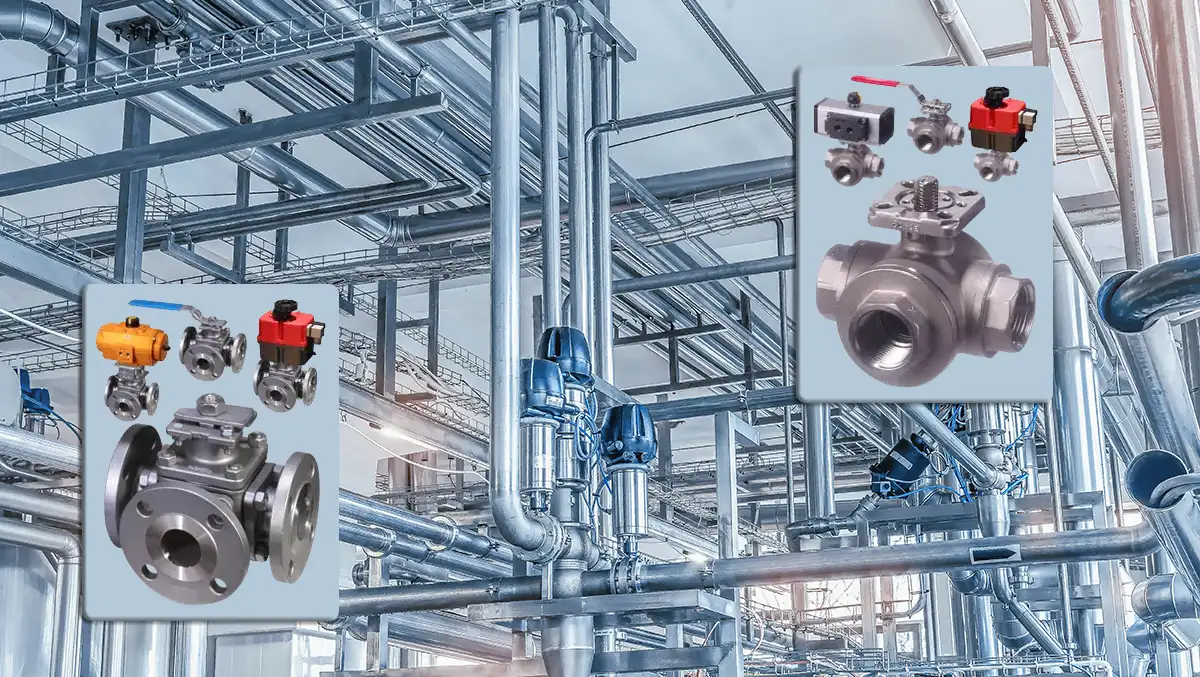
Choosing an L-port or T-port 3-way ball valve looks like a small configuration decision on a spec sheet. In practice, it determines whether the valve does what the process actually needs it to do. Get it wrong, and the mistake usually doesn’t surface until commissioning — after the valve is already piped, welded, flanged, or glued into the line.
A 3-way ball valve can do the job of a tee fitting plus two separate 2-way valves, in a single body. That’s a real advantage on space-constrained skids and in tight piping runs. But it only pays off if the ball bore inside the valve actually matches the flow pattern the application calls for: diverting, mixing, or bypassing.
How L-Port and T-Port Ball Geometry Sets the Flow Path
A 3-way ball valve looks like a standard ball valve with an extra port. What matters is the shape drilled into the ball itself.
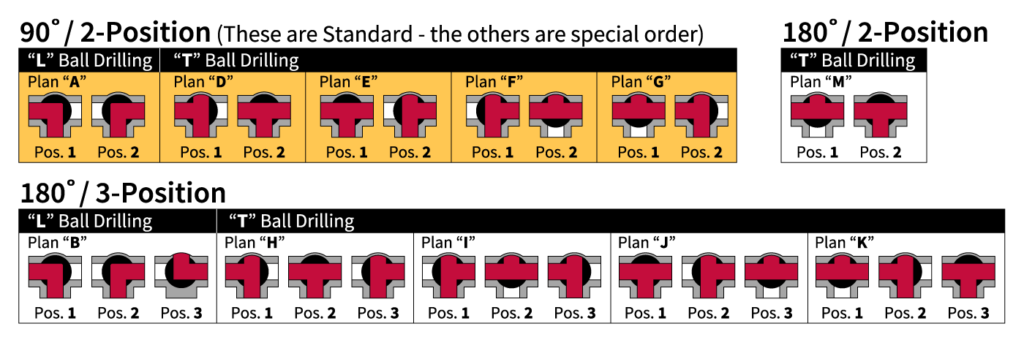
- L-port: The bore is machined in an L shape. It connects the common port to one of the two remaining ports at a time — never both, and never all three. It cannot blend the flow from two inlets into a single outlet.
- T-port: The bore runs straight through with a branch. It can switch flow the same way an L-port does, but it can also connect two ports simultaneously, or all three at once, depending on the specific drilling and stop positions.
That distinction — one path at a time versus multiple paths at once — is what decides whether a given valve can divert, mix, or bypass. Confirm the flow diagram against the manufacturer’s actual drilling before specifying; not every “T-port” opens the same combination of ports.
L-Port Valves for Diverting Service
Diverting is the more straightforward of the two jobs: send flow from one common port to either of two outlets, never both at once. L-port valves are built for exactly that.
Typical diverting applications include switching a pump’s discharge between a primary and backup line, alternating flow between two storage tanks, or routing product to one of two downstream processes without ever mixing them. Because the L-port bore physically isolates the third port in either position, it also delivers cleaner shutoff between the two outlet legs than a T-port can offer in the same role.
31D Series brass 3-way ball valves are a common fit for general-purpose diverting service in NPT-threaded systems up to 3 inches, available with direct-mount pneumatic or electric actuation in place of the manual handle.
T-Port Valves for Mixing and Blending Service
A mixing application needs a valve that can connect two inlets to a single outlet at the same time — something an L-port simply cannot do. This is where the T-port’s ability to open multiple ports simultaneously earns it a place in the system.
Common T-port applications include blending hot and cold water to a set temperature, combining two process chemicals before a reaction step, or splitting a single supply between two downstream lines. Because flow can pass through all three ports depending on the ball position, T-port valves also support straight-through flow when the process requires it.
Material selection matters as much as port geometry here. PTP Series PVC 3-way ball valves are a practical option for corrosive or water-based blending service where metal isn’t required, while food, beverage, and pharmaceutical mixing applications typically call for the sanitary, tri-clamp 30D Series, which is 3-A approved for clean-service use.
Using Actuated 3-Way Valves for Bypass and Isolation
Bypass service is a different problem than diverting or mixing: the goal is to route flow around a piece of equipment — a filter, heat exchanger, or instrument — during maintenance, or to hold a line in a safe position while the primary path is isolated.
A single, properly ported 3-way valve can do this in place of a tee fitting and two separate 2-way valves. That means fewer joints, less welding or gluing, and one less potential leak point — a real consideration on equipment skids where space is already tight.
For higher-pressure or higher-temperature bypass loops, especially in larger process piping, the flanged, trunnion-supported MPF Series is built for 150# and 300# ANSI service from ½ inch to 6 inches, in carbon or stainless steel.
Actuator Rotation and Piping Arrangement: Where Selection Mistakes Happen
Port geometry only solves half the problem. The other half is confirming that the actuator and piping arrangement actually support the specified flow pattern.
Most 3-way ball valve actuators are sized for a standard 90-degree quarter-turn, which is sufficient for basic L-port diverting or two-position T-port switching. But some T-port flow patterns — particularly those designed to reach a straight-through or all-ports-open position — require a 180-degree rotation range that a standard actuator won’t provide. Specifying the wrong rotation range is one of the more common, and more expensive, mistakes in 3-way valve selection, since it’s usually caught during startup rather than during design.
Piping orientation matters just as much. Confirm which port is the common port, verify the flow plan against the manufacturer’s actual documentation rather than assuming a universal convention, and check that the mounting orientation won’t allow media to settle in a dead leg. 33D Series stainless steel 3-way ball valves support direct-mount pneumatic and electric actuation, which removes the actuator-mounting-kit variable from the equation entirely.
These are the kinds of details covered under ASME B31.3, the Process Piping code, which governs materials, design, and installation requirements for pressure piping components — including valves — across chemical, pharmaceutical, and general process industries. It’s a useful reference point for confirming that a 3-way valve’s installation, not just its selection, meets the same standards as the rest of the system.
Matching Port Configuration to Your Application
There’s no single “right” 3-way ball valve — only the right one for a specific flow pattern, media, and piping arrangement. As a starting point:
- Diverting between two outlets, never mixed: L-port
- Blending two inlets, or need straight-through flow: T-port
- Routing around equipment for maintenance or isolation: either port type, sized to the application
- Sanitary or corrosive service: match the body material and end connection to the media before finalizing port type
Getting this right at the spec stage avoids the more expensive option: discovering during commissioning that the valve on hand can’t do what the process needs.
When an application doesn’t fit a standard catalog configuration, it’s worth reviewing the full range of available flow plans and actuation options before finalizing a spec, rather than defaulting to the 3-way valve that happens to be on hand. Not sure which port configuration, material, or actuation setup fits a specific application? Contact Assured Automation’s valve automation experts — they’ll work through the flow requirements with you and help confirm the right 3-way valve before it goes into the piping.

General Manager