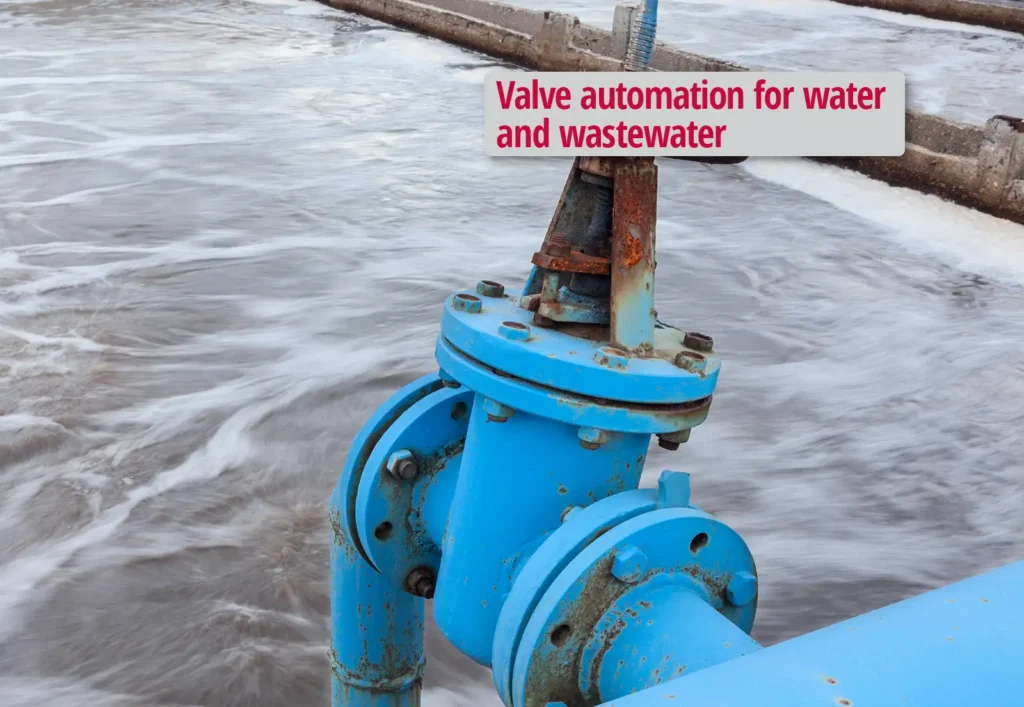
Valve automation for water and wastewater infrastructure is entering its busiest stretch in decades. The EPA’s most recent needs assessments put the price tag at $625 billion for drinking water infrastructure and $630 billion for wastewater and stormwater systems, both over the next 20 years (EPA, 7th Drinking Water Infrastructure Needs Survey and Assessment; EPA, 2022 Clean Watersheds Needs Survey).
Most of that spending isn’t new capacity — it’s replacing pipe, valves, and control systems that have been running continuously since long before automation was standard practice.
For design engineers and plant managers scoping these retrofits, the decisions made today — materials, actuation, and position feedback — will be in service for 30 to 50 years. In a retrofit, unlike new construction, the failure modes are already known, what’s corroding, what’s clogging, what’s failing under pressure. That operating history should drive the spec as much as pipe size does.
Why Valve Automation for Water and Wastewater Infrastructure Is Accelerating
Distribution and transmission — the buried pipe and valve network itself — accounts for 67% of the EPA’s drinking water needs estimate. Much of the infrastructure installed during the mid-20th-century expansion is reaching end of service life at the same time, and Infrastructure Investment and Jobs Act State Revolving Fund dollars are moving projects utilities had deferred for years into active bid packages.
That funding comes with real deadlines. A project competing for SRF dollars typically has a defined design life and a review process that expects the engineer to justify material and actuation choices against current site conditions — not simply match what was installed in the 1960s or ’70s.
Choosing Valve Materials for Corrosive and High-Solids Service
Matching valve material to actual site conditions matters more in a retrofit than in new construction, because the environment is already documented by decades of operating history. Assured Automation’s actuated valve line covers the material range this kind of project typically calls for:
- PVC and plastic — cost-effective for non-corrosive lines and smaller-diameter service
- Ductile iron — large-diameter mains and buried service where structural durability matters most
- Stainless steel — chemical dosing and chlorination areas
- PFA-lined — aggressive chemical exposure, including ozone treatment trains
Chemical dosing and chlorination areas call for materials that can shrug off a corrosive process stream, not just a corrosive external environment. Assured Automation’s 33D Series stainless 3-way ball valve is a fit here — 316 stainless steel construction rated to 800 PSIG and up to 400°F, well past what dosing service typically demands, which leaves margin for whatever the process throws at it over a multi-decade service life.
Wastewater collection systems add a specific failure mode worth flagging: hydrogen sulfide gas released from septic conditions in force mains and lift stations converts to sulfuric acid on exposed surfaces above the waterline, attacking standard concrete and unprotected metal. It’s one of the more common reasons a valve or fitting that looked fine on paper fails early in collection system service — and it’s a good reason to confirm material compatibility for anything installed near a force main discharge or lift station wet well, not just judge the spec on pressure rating.
For isolation duty on PVC lines, Assured Automation’s FE Series PVC butterfly valve offers an all-PVC body and EPDM liner built for water and light industrial service, with sizes from 1½” to 12″ to cover branch lines and larger mains.
For diverting and mixing service—such as routing flow between treatment trains, bypassing a unit process for maintenance, or splitting flow during peak wet-weather loading—the PTP Series 3-way PVC ball valve provides an L-port or T-port option for corrosive liquids and process control. By replacing a tee-and-two-valve setup with one automated valve, it can reduce actuators, solenoids, and control panel I/O in retrofit designs.
Actuator and Enclosure Choices for Outdoor and Below-Grade Installations
Much of this equipment doesn’t live indoors. Valve vaults, wet wells, and outdoor treatment trains expose actuators to moisture, temperature swings, and washdown — conditions that call for a weatherproof enclosure rating as a baseline, not an upgrade. Assured Automation’s standard electric actuator packages, for example, are commonly configured with a NEMA 4/4X weatherproof rating suited to continuous outdoor exposure.
Some installations go further — confined-space vaults or areas with a hazardous-atmosphere classification carry their own code requirements beyond standard weatherproofing. If a project includes any classified space, that’s worth flagging a valve automation specialist early, before the actuator package is locked into the design.
Position feedback matters as much as the enclosure rating. Positioners and limit switches let an operator confirm valve position remotely, without a physical site visit to a buried vault or a remote lift station — the difference between a five-second SCADA check and a truck roll to a site that might be a 30-minute drive away.
Pneumatic actuation is common where instrument air is already available, and NAMUR solenoid valves and filter-dryers belong in the same conversation as the actuator rating — moisture in the air supply is one of the more common causes of premature actuator failure in outdoor, high-humidity treatment environments.
Why Fewer Field Staff Makes Automation Non-Negotiable
The case for automation isn’t only about the funding cycle — it’s also about who’s available to run what gets built. AWWA’s 2025 Utility Benchmarking Survey found that 21% of utility employees are currently eligible to retire within five years, against an average vacancy rate of 9% (AWWA, 2025 Utility Benchmarking Survey).
That combination — a wave of capital replacement work arriving at the same time as a shrinking, less experienced workforce — is why remote actuation and position feedback are becoming standard spec rather than an added feature. Fewer field staff means fewer people available to manually operate or physically check a valve, especially across a distributed system with multiple remote sites.
A newer operator watching a SCADA screen with clear position feedback can manage a system safely with far less site-specific institutional knowledge than manual valve operation demands — which matters as the operators who know “how this particular valve behaves” retire out of the workforce faster than they can be replaced.
Talk to an Assured Automation Valve Automation Expert
Aging infrastructure retrofits rarely fit a single standard spec. Site-specific corrosion conditions, unusual pipe diameters, classified spaces, or existing control architecture can all push a project outside a catalog part number — and getting that wrong on a project with a 30-plus-year service life is an expensive mistake to make twice.
Assured Automation’s in-house valve automation experts work directly with design engineers and plant managers to match material, actuation, and feedback specs to the actual conditions of a retrofit, not just the conditions on a spec sheet. That same team can generate downloadable CAD models for the exact valve and actuator assembly being specified, which typically saves real time building a submittal package against an SRF-funded project deadline.
Whether you’re scoping a single lift station upgrade or a multi-site capital replacement program, contact Assured Automation before the design is locked in. It’s easier to get the spec right at the front end than to correct it after installation.

General Manager