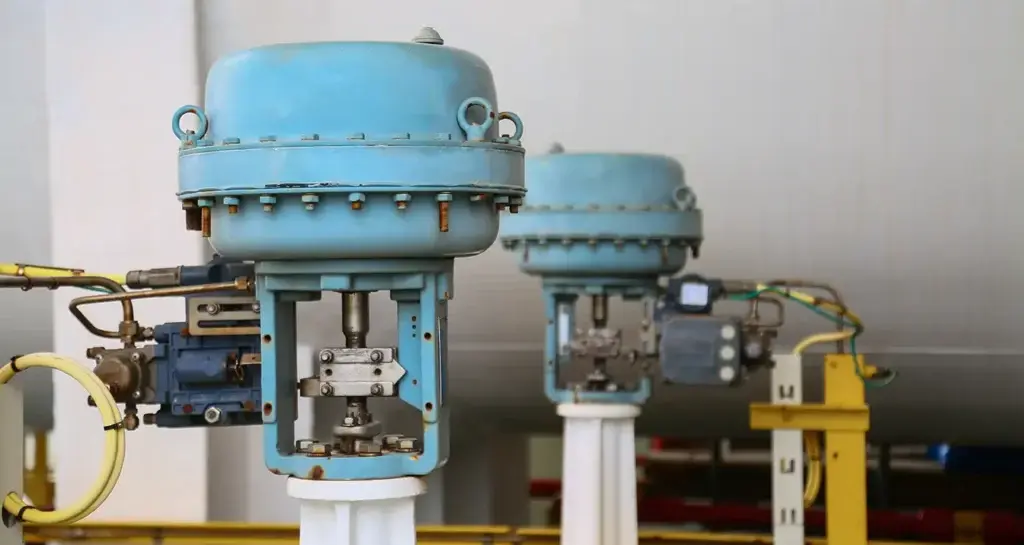
Engineers often ask us for a globe control valve alternative when a project budget is tight, or a replacement is needed fast. Globe valves have been the default for modulating control for decades. There are good reasons for that. But they are not the only option, and they are not always the best fit.
V-port ball valves now handle many throttling jobs that engineers used to assign to a globe valve out of habit. They do not replace globe valves everywhere. This post covers where each one fits and which positioner options turn a V-port ball valve into a capable control valve.
Why Engineers Look for a Globe Control Valve Alternative
A globe control valve is an engineered product. Plug style, trim, and port size are matched to the flow, pressure drop, and fluid. That precision has a price. Our own globe control valves are made to order, and we ask for a completed application data sheet before we quote.
For a new process line, that effort pays off. For a plant manager replacing a failed heat exchanger valve, or an MRO buyer trying to get a loop back online, it can mean higher costs and a longer wait. The real question is simple: does this loop actually need a globe valve?
We covered the basic differences in an earlier comparison of globe and V-port ball valves. This post goes a step further, with practical selection criteria and actuation choices.
How a V-Port Ball Valve Controls Flow
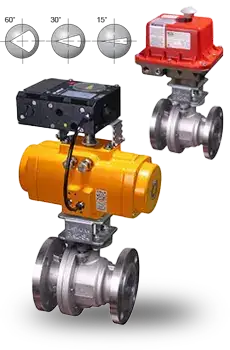
A V-port ball valve is a quarter-turn ball valve with a V-shaped opening cut into the ball. As the valve rotates open, the V exposes a gradually widening flow path. That produces a characterized flow curve suited to throttling.
A standard round-port ball valve behaves very differently. It passes most of its flow early in the rotation, making stable control difficult.
The angle of the V sets the flow range. Common options are 60°, 30°, and 15°. A narrower V gives finer control at lower flows. A wider V passes more flow. The same body can accept different balls, so the valve can be matched to the application without changing line size.
When a V-Port Ball Valve Makes Sense for Modulating Flow Control
A V-port ball valve is a practical choice when the loop looks like this:
- Moderate-precision control: temperature control on heat exchangers, level control, and general flow regulation where the loop does not demand the finest resolution.
- Tight shutoff is needed: with resilient seats, a V-port valve can provide positive shutoff in addition to throttling.
- High flow capacity in a given line size: the straight-through rotary design typically delivers more flow than a globe valve of the same size.
- Dirty or fibrous media: the edge of the V shears against the seat as it closes, which helps it resist clogging.
- Budget or lead time pressure: standard sizes are configured from stock components rather than engineered to order.
- Plant standardization: the valve uses the same style of quarter-turn actuators and accessories your maintenance team already supports.
That last point matters more than it may seem. A specialty chemical plant we worked with replaced costly globe valves on its heat exchangers with V-port ball valves, using standard pneumatic actuators and electro-pneumatic positioners already common throughout the plant.
Our V150F Series V-port ball valves are a good example of this approach. They come with ANSI Class 150 flanged connections from 1/2″ to 8″, in stainless or carbon steel. The throttling element is a solid stainless steel ball, not a seat insert, so it avoids the clogging and premature wear that inserts can suffer. The same V-port design is also offered as the V300F Series for ANSI Class 300 flanged lines, and as the V200/300 Series with NPT and socket weld ends. Sizes and options can be priced in our online valve configurator.
When a Globe Control Valve Still Wins
A V-port ball valve is not the right answer for every loop. A globe valve remains the better choice in these situations:
- Fine control across a wide turndown: linear and equal percentage plugs give finer resolution, especially at low flows. Our GH2F Series high-capacity globe control valves, for example, offer 50:1 rangeability.
- High pressure drop or cavitation risk: ball valves are high-recovery designs. Cavitation and choked flow can start at lower pressure drops than in a globe valve, which can also be fitted with specialized trim.
- Continuous, high-duty-cycle modulation: a valve that moves all day benefits from the globe design, which does not suffer the uneven seat wear a ball valve can see when it throttles near mid-travel for long periods.
- Three-way mixing or diverting control: globe valves are available in 3-way configurations. V-port ball valves are a 2-way flow control solution.
- Very high temperatures: our GVI Series industrial globe control valves are designed for service from -20°F to 800°F.
If your application falls into one of these categories, the higher cost of a globe valve is usually justified.
Positioner Options for V-Port Ball Valve Flow Control
A V-port ball valve is only as good as the actuator and positioner driving it. This is not a minor detail. Researchers studying industrial process data have reported that about 30% of control loops oscillate because of control valve problems such as stiction, deadband, and hysteresis.
The positioner is what closes that gap. It compares the control signal to the actual valve position and corrects the difference. Here are the most common choices:
Electro-pneumatic positioner with a pneumatic actuator. This is the most common package in processing plants. The positioner takes a 4-20 mA signal from the controller and converts it into air pressure to drive the actuator. Spring-return actuators add a defined fail position.
Pneumatic positioner. This accepts a 3-15 psi pneumatic signal. It still makes sense in plants with existing pneumatic instrumentation.
Electric modulating actuator. A positioner board inside the actuator accepts a 4-20 mA or voltage signal. No instrument air is required. Check the actuator’s duty cycle rating and stroke speed against the loop. Our S4 Series electric actuators offer modulating control and a fail-safe battery option.
You can review our pneumatic and electro-pneumatic valve positioners to compare options.
Sizing matters as much as the positioner. An oversized valve spends most of its life near the closed position, where control is weakest. We size V-port ball valves for our customers, so there is no need to run complex sizing calculations on your own.
Choosing Between a V-Port Ball Valve and a Globe Valve
Start with the loop, not the valve. Ask how much precision the process really needs, what pressure drop the valve will see, and how often it will modulate. If the answers point to moderate precision, manageable pressure drop, and intermittent modulation, a V-port ball valve is worth a serious look.
If the loop demands fine control, high pressure drop, or constant movement, a globe valve still earns its place.
Not sure which way your application leans? Start a conversation with one of Assured Automation’s valve automation experts.

Vice President of Sales