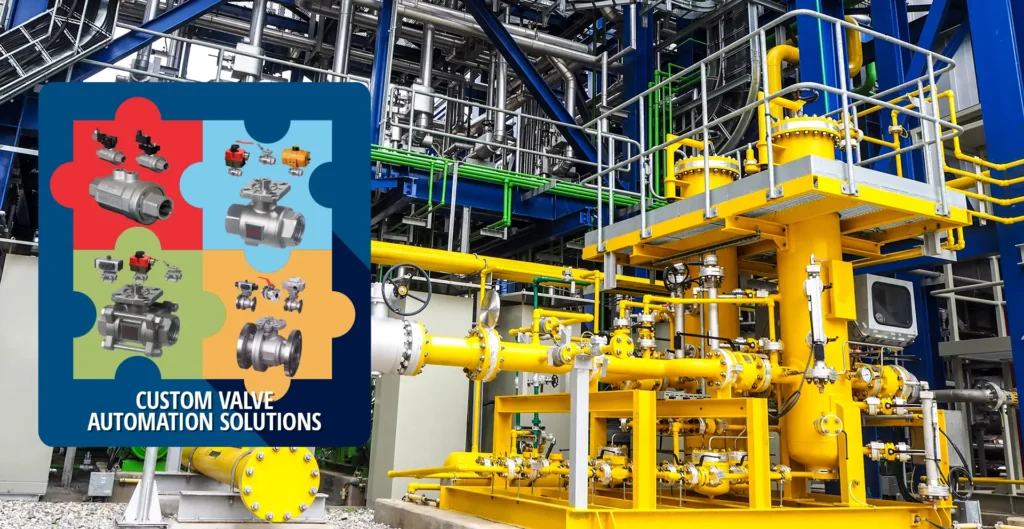
Custom valve automation doesn’t always mean starting from scratch. More often, it is about solving one critical application detail that prevents a standard actuated valve assembly from being the right solution.
The valve body may be suitable, but the actuator does not provide the required fail-safe action. The valve may perform correctly, but it will not fit the available space.
An OEM may need to automate an existing valve instead of replacing it. A plant may need position feedback, local controls, special cleaning, safety lockout, or a compact assembly that reduces piping and installation time.
These are not unusual problems. They are the practical details that often determine whether an automated valve package works reliably in the field.
Assured Automation’s online configurators are an efficient way to specify many complete valve assemblies. Start there when a standard product meets the application. But when the configuration is close—not exact—contact the Valve Automation Experts.
The Valve is Right, but it Cannot be Automated as Required
Many replacement and retrofit projects begin with an existing valve that is still suitable for the process.
The valve may not have an ISO mounting pad. It may have an unusual stem, bolt pattern, or space restriction. Replacing the entire valve could mean modifying piping, extending a shutdown, or creating unnecessary expense.
In these situations, custom valve automation may involve a mounting kit rather than a completely new valve assembly.
Assured Automation has fabricated custom mounting kits to add limit switches to customer-supplied manual valves. It has also supplied retrofit mounting kits and spring-return pneumatic actuators for existing flanged ball valves.
The important point is that automation does not always require replacing every component. Sometimes the right solution is to properly adapt the existing equipment.
The Required Fail Position is Not Available in a Standard Package
A valve’s action during a loss of power or air is not a minor detail. In many industrial applications, it is a safety, process protection, or environmental requirement.
A basic electric or pneumatic actuator may not provide the required response.
Assured Automation offers standard spring-return pneumatic actuators for common fail-open and fail-closed applications. But some applications require a different approach.
For example, Assured Automation has supplied a custom spring-return electric motor operator that operated normally when power was available and moved the valve to a preselected fail-safe position when power was lost.
The Controls and Feedback Must Work with the System
An actuated valve is not just a valve and an actuator. It is part of a larger control system.
A customer may need confirmation of open/closed status at a PLC. Another may require a solenoid valve, a positioner, a local control box, a manual override, or an explosion-proof enclosure. These components must work together mechanically and electrically.
Assured Automation’s valve accessories include limit switches, NAMUR solenoid valves, positioners, and other control components. In some cases, the challenge is not selecting an accessory, it is integrating several accessories into one practical assembly.
For example, a refinery application required a fire-safe automated ball valve, a spring-return pneumatic actuator, an explosion-proof limit switch, and an explosion-proof solenoid. The selected limit-switch package provided extra terminals for solenoid termination inside the enclosure, helping eliminate explosion-proof seal-offs and reduce contractor installation time.
A Compact Assembly Can Eliminate a Larger Design Problem
Space restrictions are common in OEM equipment, skids, test stands, retrofits, and crowded plant installations.
The usual response is to search for a smaller valve. But the valve body may not be the only issue. The actuator, mounting hardware, solenoid, limit switch, piping, and tubing all add to the overall size of the assembly.
Assured Automation has helped OEMs reduce machine size and weight by using one actuator to operate two ball valves simultaneously. In another project, it recommended compact VA Series coaxial valves mounted on a manifold to eliminate separate actuator mounting hardware and simplify piping.
The VA Series is particularly relevant where high-cycle, fast on/off performance and compact installation are required. Its pneumatic actuator is integrated into the valve body, eliminating external mounting kits and exposed moving parts.
Special Service Requirements Can Change the Entire Specification
A valve may look standard until the process conditions are considered.
Oxygen service, sanitary processing, high-purity media, corrosive chemicals, high-cycle operation, or special materials requirements can change the requirements for valves, actuators, seals, accessories, cleaning, testing, and documentation.
For oxygen service, Assured Automation has provided oxygen-cleaned 26 Series stainless steel ball valves for customers who require special cleaning and certification. For sanitary applications, its 36 Series three-piece stainless steel ball valves are available with Tri-Clamp connections, optional cavity filled seats, and automation accessories.
Safety and Maintenance Requirements May Drive the Decision
In some applications, a standard valve can handle the pressure and temperature requirements but still fall short on safety or maintenance needs.
A refinery, chemical plant, or process facility may need fire-safe construction, safety lockout, position indication, or a specific actuator/accessory combination.
A maintenance team may need a clear visual indication that a valve is locked open or closed. An engineer may need a package that reduces the number of separate components to inspect and maintain.
Assured Automation’s 150F Series flanged ball valves are one example. Fire-safe versions are available with graphite seals, and the series can be supplied with actuators, limit switches, solenoids, positioners, and manual override devices.
The right valve automation solution should support safe operation, installation, and maintenance—not simply open and close on command.
When a requirement does not appear as a standard option, contact Assured Automation with as much application information as possible. A photo, drawing, existing part number, P&ID, control description, clearance dimension, or list of required accessories can help identify the best approach.
The solution may be a standard configured assembly. It may be a special mounting kit, a different actuator, a compact manifold package, a custom control arrangement, special cleaning, or a fully custom valve automation solution.
Do not settle for the closest match. Talk to our Valve Automation Experts about the details that make your application different.

Vice President of Sales