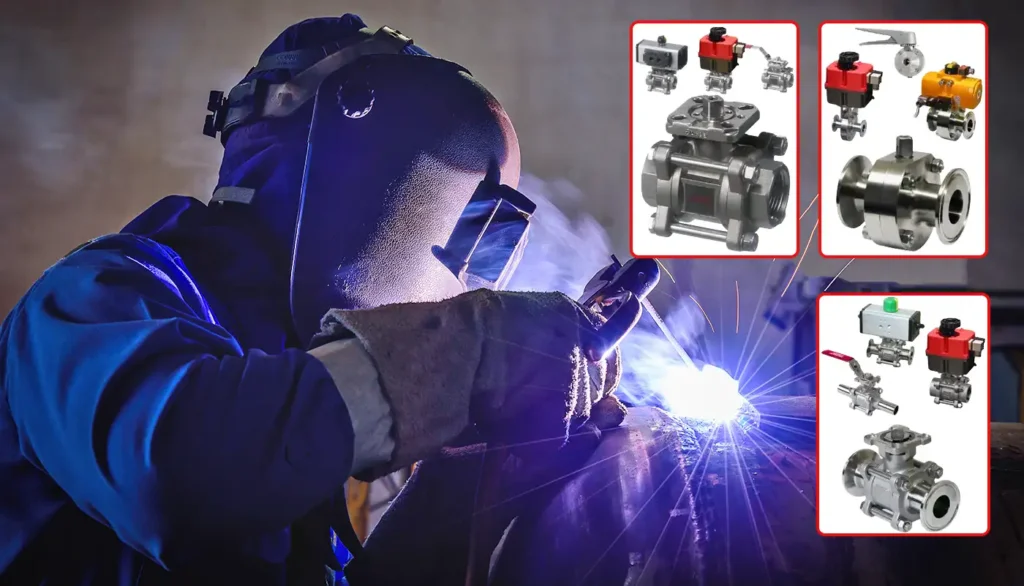
Welded valve connections deserve careful consideration. They are easy to overlook until they create a problem. A valve may be correctly sized, properly automated, and made from the right materials. However, the wrong end connection can still lead to leakage, installation headaches, maintenance problems, or unnecessary downtime.
Welded valve connections are not automatically better than threaded, flanged, or clamp-style connections. They are better for certain applications. In other situations, they can make maintenance more difficult and increase installation costs.
The right choice depends on the piping system, media, pressure, temperature, cleanliness requirements, inspection needs, and how often the valve may need to be serviced or replaced.
This article explains when welded valve connections make sense, when they do not, and how socket weld, butt weld, and extended tube butt weld connections differ.
What Are Welded Valve Connections?
A welded valve connection joins the valve directly to the pipe or tubing by welding. Instead of using threads, bolts, gaskets, or clamps, the valve becomes a permanent part of the piping system.
That permanence is the main advantage and the main limitation.
A welded connection can reduce potential external leak paths and provide a strong, compact connection. It can also help in applications where vibration, thermal cycling, pressure, or cleanliness requirements make threaded or gasketed joints less desirable.
However, once a valve is welded into the line, removal is not as simple as unbolting a flange or loosening a clamp. Maintenance planning becomes more important. So does installation quality. Welded valve connections must be performed by qualified personnel in accordance with the applicable project specifications, piping codes, and manufacturer’s instructions.
A Brief Note About Standards
Welded valve connections are usually specified as part of broader piping and valve requirements. ASME B16.34 covers valves with flanged, threaded, and welded ends, including requirements for pressure-temperature ratings, dimensions, tolerances, materials, testing, and marking.
ASME B16.11 is commonly associated with socket-welding and threaded forged fittings.
ASME B16.9 covers factory-made wrought buttwelding fittings.
These standards are useful references, but they do not replace application review. The final connection choice still depends on the media, operating conditions, valve design, industry requirements, and maintenance expectations.
Socket Weld Connections: Compact and Reliable for Smaller Lines
A socket weld connection uses a recessed socket in the valve end. The pipe is inserted into the socket, and the weld is made around the outside edge of the connection.
Socket weld connections are commonly used in smaller pipe sizes where a permanent, rugged connection is preferred over threaded connections. They can be a good choice when the application requires better leakage resistance than threaded pipe connections, especially where thread sealant, thread galling, or vibration-related loosening may be concerns.
For example, the 36 Series stainless steel ball valves are available with socket weld ends for applications that need a full-port, three-piece stainless steel ball valve with a welded connection.
The 38 Series stainless steel ball valves also offer socket weld connections, making them suitable for applications that require stainless steel construction and welded installation.
Socket weld connections are also available on the HPF Series fire-safe ball valves, which are used in more demanding industrial services, including steam, slurries, semi-solids, corrosive services, chemical, power, gas, paper, and OEM applications.
For control applications, the GVI Series industrial globe control valves offer socket weld connections for welded installations and modulating flow control.
The V200/300 Series V-port ball valves are another example. These valves are used for flow modulation and are available with NPT or socket-weld connections.
In applications involving general service or slurry flow, a socket weld V-port ball valve may offer the combination of permanent installation, controllable flow, and simplified maintenance compared with some traditional globe valve options.
Socket weld connections do have limitations. The pipe slips into the valve socket, creating a small internal crevice. In some applications, that crevice is not a concern. In others, it can trap fluid, solids, or contaminants. That makes socket weld connections less attractive for applications where cleanability, high purity, corrosion concerns, or product entrapment are major issues.
In short, socket weld connections make sense when the system needs a compact, permanent, leak-resistant connection and the small internal crevice is acceptable for the service.
Butt Weld Connections: Cleaner Flow Path and Strong Piping Integrity
A butt weld connection is different. The pipe end and valve end meet end-to-end. The ends are prepared, aligned, and welded around the joint. Unlike socket weld connections, the pipe does not insert into a socket.
This design can provide a smoother internal flow path with fewer crevices. That makes butt weld connections a strong choice in sanitary, high-purity, and process applications where trapped fluid or contamination is unacceptable.
The BFY Series sanitary butterfly valves are a good example. These valves are available with tri-clamp or butt-weld connections and are used in food and beverage, dairy, brewing, wine, pharmaceuticals, chemical processing, flavor, fragrance, and CIP line applications. In sanitary tubing systems, butt weld ends can help create a permanent, cleanable piping connection.
Butt weld connections are also available on Assured Automation’s GV Series precision globe control valves, including the GV2F 2-way flow control valves and the GV3D/GV3M 3-way diverting and mixing configurations. These valves are used for precise modulating control in applications involving pressure, temperature, level, and flow. Where the piping system calls for welded construction, butt weld ends allow the control valve to become part of that permanent system.
Butt weld connections are often preferred when internal cleanliness, joint strength, and piping continuity matter. They can reduce crevices compared with socket-weld designs and avoid potential leakage points associated with threaded connections.
The tradeoff is installation. Butt welding typically requires more precise alignment and preparation than socket welding—the quality of the weld matters. So does heat control, especially with valves that contain soft seats, seals, or internal components that can be damaged by excessive welding heat.
For that reason, the valve manufacturer’s installation instructions should always be followed. Depending on the valve design, seats, seals, or other components may need to be protected or removed before welding.
Extended Tube Butt Weld Connections: Moving Heat Away from the Valve Body
Extended tube butt weld connections are a variation of butt weld connections. The valve includes longer tube ends so the weld area is farther away from the valve body, seats, and seals.
This matters because welding creates heat. Too much heat near the valve body can damage internal components, especially soft seats and seals. Extended tube ends provide more distance between the weld and the valve internals, reducing the risk of heat-related damage during installation.
The 38 Series stainless steel ball valves offer extended tube butt weld connections. This option is useful when a butt weld connection is needed, but additional distance from the valve body is preferred during welding.
Extended tube butt weld connections are especially relevant in sanitary and clean process systems where welded tubing is common and where minimizing internal crevices is important. They can provide the benefits of a permanent butt weld connection while helping protect the valve during installation.
When Welded Valve Connections Make Sense
Welded valve connections are a good fit when the piping system is intended to be permanent, and long-term leakage risk must be minimized.
They are often specified when threaded joints are not preferred due to pressure, temperature, vibration, chemical compatibility, or maintenance concerns. They are also useful where a compact connection is needed, and there is no practical reason to install flanges.
Welded valve connections may be the right choice when:
- The system is permanent and not frequently modified.
- External leak paths must be reduced.
- Threaded connections are not suitable for the media or service conditions.
- The piping system is exposed to vibration or thermal cycling.
- The application requires sanitary or high-purity piping.
- The valve is part of a skid, OEM package, or compact process assembly.
- The plant or project specification calls for welded construction.
The application should drive the decision. A socket-weld ball valve may be the right choice for a compact industrial utility line. A butt weld sanitary butterfly valve may be better for a clean process line. An extended tube butt weld ball valve may make sense where the installer needs more distance between the weld and the valve body.
When Welded Valve Connections May Not Be the Best Choice
Welded valve connections are not ideal for every application.
If the valve must be removed frequently for cleaning, inspection, repair, or replacement, a welded connection can create unnecessary work. In those situations, flanged or tri-clamp connections may be a better option.
Welded connections may also be a poor fit for temporary systems, pilot lines, or piping layouts that are expected to change. Cutting out and replacing a welded valve takes more time than removing a threaded, flanged, or clamped valve.
Socket weld connections also require careful review in applications where trapped fluid is a problem. If the media is corrosive, sticky, sanitary, or prone to contamination, the internal crevice of a socket weld connection may be unacceptable. In those cases, butt weld or extended tube butt weld connections may be more appropriate.
Installation capability is another factor. Welding should not be treated casually. If qualified welders, procedures, inspection requirements, or heat-control practices are unavailable, a welded valve connection can pose more risk than benefit.
Match the Connection to the Application
There is no single best valve end connection. Each option has a purpose.
Socket weld connections are compact, rugged, and well-suited for many smaller industrial piping systems. Butt weld connections offer a cleaner internal flow path and are often preferred in sanitary, high-purity, and process applications. Extended tube butt weld connections add distance between the weld and valve body to help protect internal components during installation.
The decision should be based on the application, not habit.
Before selecting a welded valve connection, consider the media, pressure, temperature, pipe size, cleanliness requirements, maintenance access, installation method, and applicable standards. Also consider how the valve will be automated and serviced over time. Need help selecting the right welded valve connection for your application? Talk to the valve automation experts at Assured Automation.